
How to Find Startup Ideas That People Will Actually Pay For

42% of startups fail because no one actually needs their product. If you're wondering how to find startup ideas that people will actually pay for, the difference between success and that statistic comes down to validation, not inspiration.
You'll walk away with a repeatable, data-backed validation framework that lets you test any startup idea in days instead of months, dramatically raising your odds of building something customers will pay for.
Why Most Startup Ideas Never Become Businesses
Approximately 20% of new businesses fail in their first year, according to Forbes Advisor data. That number climbs to about 50% within the first five years. These figures underscore why idea selection carries such weight. Founders often chase concepts that feel exciting without confirming whether anyone faces the problem at scale.
No market need stands out as the leading culprit. CB Insights reports that 42% of startups fail due to no market need for their product or service. Teams pour resources into solutions that solve imaginary pains, only to discover later that potential buyers have workarounds or simply do not care enough to switch.
Cash shortages compound the issue. Another 29% of failures tracked by CB Insights trace back to running out of cash. When an idea lacks demand from the start, revenue stays flat and investors lose patience. Poor idea choices therefore create a cascade: weak traction leads to quicker burnout of runway, and the absence of paying customers makes additional fundraising difficult.
The pattern repeats because many founders treat inspiration as sufficient proof. They skip the step of confirming that a real audience experiences the pain acutely and will pay to resolve it. Shifting focus to early validation changes the odds before significant time or capital enters the picture.
The #1 Reason Startup Ideas Fail
CB Insights data shows that 42% of startups fail due to no market need for their product or service. This single factor outpaces every other cause. The problem usually surfaces after months of development, when the product launches and adoption never materializes.
Demand rarely appears after a polished build. It exists beforehand, expressed through search behavior, complaints in forums, or willingness to pay for alternatives. Skipping direct tests leaves founders guessing about urgency and price sensitivity. They interpret polite feedback as interest when actual purchase intent remains unmeasured.
Validation before building reverses this sequence. A founder can run small experiments that reveal whether the problem ranks high enough for people to change routines or budgets. When signals stay weak, the idea gets discarded early. When signals strengthen, the team gains evidence that paying customers already exist. The 42% failure rate drops when this check happens first.
How Team Composition Affects Idea Success
CB Insights attributes 23% of startup failures to team-related issues. Skill gaps, mismatched priorities, or missing execution roles turn even promising ideas into stalled efforts. Complementary strengths matter more than any single founder trait.
Startups founded by a "Hipster, Hacker, and Hustler" team are twice as likely to succeed, based on arXiv research. The Hipster handles design and user experience, the Hacker owns technical feasibility, and the Hustler drives sales and partnerships. This mix covers the three core functions required to move from idea to paying customers.
When one role dominates, validation steps often get skipped or executed poorly. A technical founder might build too soon, while a sales-focused founder might chase the wrong audience. Assembling the three roles early improves both the quality of validation tests and the speed at which results translate into product decisions. see how one founder validated an AI automation idea before building
The 7-Step Validation Framework That Works
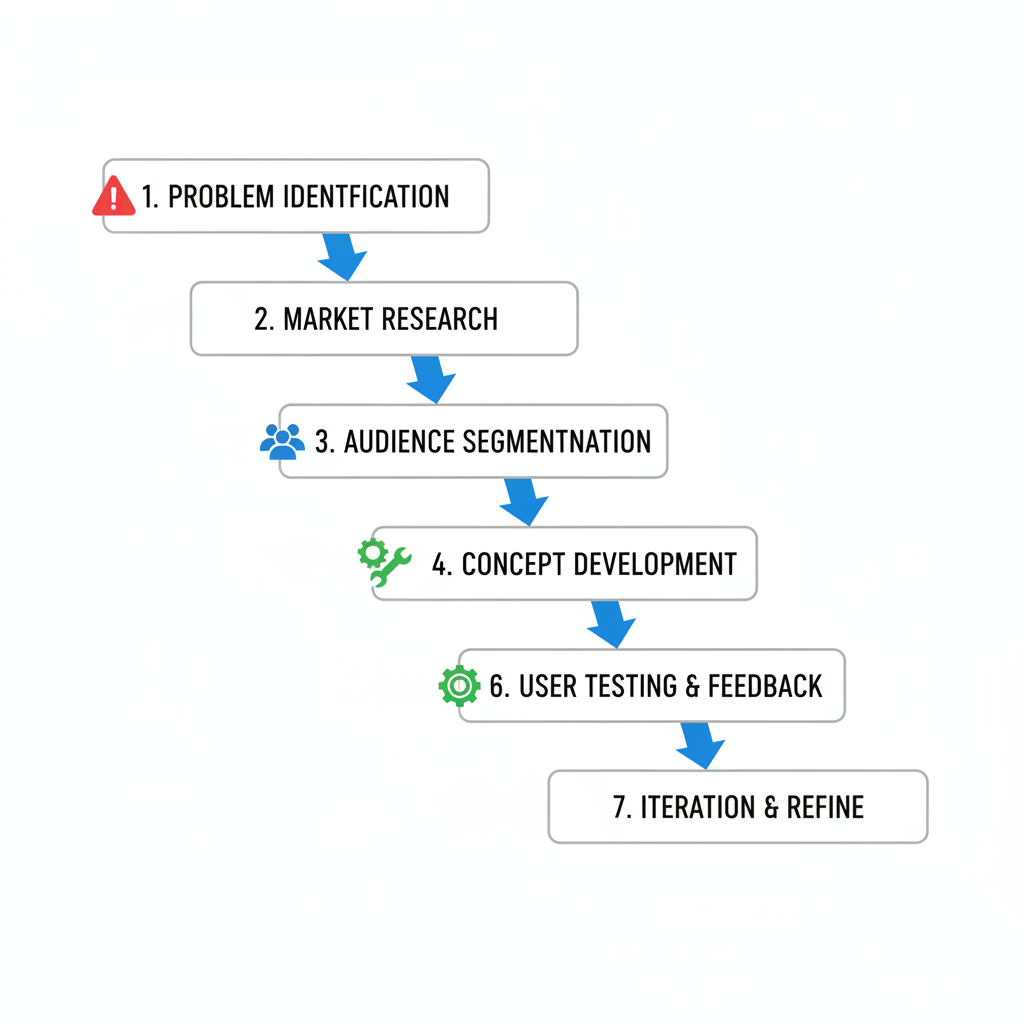
A structured approach turns vague ideas into testable hypotheses within days. StartupIdeasDB outlines a seven-step sequence that forces clarity at each stage.
- Articulate the problem in one sentence that names the specific pain and its cost.
- Define the target audience by role, company size, and current workaround.
- Scan search intent data to gauge how many people already look for solutions.
- Reach out to 20 to 30 prospects with a short problem description and record replies.
- Create a one-page landing page that describes the solution and captures email sign-ups.
- Run a rapid prototype that delivers the core benefit manually for the first five users.
- Compile signals into a single score and decide whether to continue or pivot.
Each step produces a concrete output that can be reviewed objectively. The process keeps total time under two weeks for most ideas and prevents the common pattern of building in isolation.
Measuring Real Demand with a Demand Score
Demand Discovery AI combines search intent, outreach response, landing-page engagement, and community buying signals into a Demand Score from 0 to 100. The score gives founders an objective number instead of relying on gut feel or scattered anecdotes.
Search volume shows baseline interest. Reply rates from direct outreach reveal whether the problem feels urgent enough for people to respond. Landing-page conversion tracks stated interest through measurable actions such as email sign-ups. Community signals add evidence from forums or groups where the same pain surfaces repeatedly.
Scores above 70 typically correlate with enough momentum to justify further investment. Lower scores prompt either refinement of the problem statement or abandonment before additional resources are spent. explore a validated customer-support automation concept
The framework works because it treats validation as the first product. A founder who runs one idea through these steps each week quickly accumulates data on what actually attracts buyers. Structured validation significantly increases the likelihood of developing startup ideas that meet real customer demand and achieve market success.
Start with one idea this week, run it through the validation steps, and only invest serious time once you have clear buying signals. The entrepreneurs who treat validation as the first product win more often than those who fall in love with their solution.
Related Articles

Learn AI Practical: n8n + GPT-5.6 Workflow to Automate Side Hustle Invoices
Step-by-step setup for connecting n8n with GPT-5.6 to handle invoice creation and follow-ups automatically, cutting 3 hours of weekly admin work.

AI Side Projects: Ship 83 Ideas from Incomplete to Launch-Ready with Vibe Coding in 2026
Real experiment: How AI turned stalled side hustles into MVPs—pick prompts, tools, and metrics that deliver 50% faster builds without tutorials.

AI Side Projects Make Money: Persistent Memory Agents for Market Monitoring Income
Build and deploy AI agents that monitor markets, generate content, and drive revenue 24/7 – from setup to first earnings in practical experiments.