
Using AI Automation to Cut 90% Repetitive Developer Tasks in 2026 Workflows
Over 55% of developer time still vanishes on repetitive tasks in 2026. Using AI automation to handle the first 60–90% of boilerplate, tests, and reviews is now delivering measurable cycle-time cuts for engineering teams. The promise here is a workflow playbook drawn from enterprise field experiments and PR analyses that shows precisely where to apply ai automation, the documented gains in task speed and cycle time, and the guardrails that keep quality intact while using ai for work.
Which Repetitive Developer Tasks Deliver the Biggest AI Wins
Over 55% of a developer’s time is spent on repetitive or low-value tasks such as writing boilerplate, fixing small bugs, updating documentation, refactoring, and repeatedly searching for the same answers. That concentration of effort makes these activities the clearest starting points for ai productivity gains.
- Boilerplate and documentation see roughly 80% speedups because the output is repetitive and easy to verify against existing patterns.
- Test writing improves by about 55% when AI suggests cases and edge scenarios that developers then confirm.
- Bug fixes register around 20% faster completion once an agent surfaces stack traces and proposes narrow patches.
- Architecture and complex design decisions show only marginal gains because they require judgment that current tools cannot reliably supply.
This distribution explains why teams that route the first pass of these tasks to AI agents free substantial hours without ceding control over system-level choices. The pattern also aligns with the broader observation that developers using ai for developers report higher motivation once the volume of routine work drops.
Measured Productivity Gains from Enterprise Field Experiments
Enterprise trials supply the clearest benchmarks for what using ai for work actually moves. Across 4,867 developers at Microsoft, Accenture, and a Fortune 100 firm, access to an AI coding assistant increased the number of completed tasks by about 26%, with particularly strong gains among less experienced developers. McKinsey reports that with generative AI, documenting code can take about half the time, writing new code nearly half the time, and refactoring existing code about two-thirds the time compared with traditional methods. Developers using generative AI were 25–30% more likely to finish complex tasks within given time frames.
An enterprise-scale study reported a 31.8% reduction in pull-request review cycle time with AI-assisted development tools over a full year. Prior double-controlled A/B experiments showed AI code review assistants reduced average PR review duration by 23% and per-line review duration by about 40%. Early METR trials from February to June 2025 recorded a 19% slowdown when developers used first-generation tools, yet a follow-up experiment starting August 2025 with updated tools showed an estimated 18% faster completion for returning developers.
| Metric | Reported Change | Context |
|---|---|---|
| Completed tasks | +26% | 4,867 developers across three firms |
| Code documentation time | ~50% reduction | McKinsey field data |
| New code writing time | ~50% reduction | McKinsey field data |
| Refactoring time | ~67% reduction | McKinsey field data |
| PR review cycle time | 31.8% reduction | Year-long enterprise deployment |
| Early METR tool use | 19% slowdown | Feb, Jun 2025 trial |
| Updated METR tool use | 18% speedup (returning users) | Aug 2025 onward |
These figures demonstrate that pairing ai automation with process redesign converts early neutral or negative results into sustained cycle-time improvements.
How Agentic AI Executes the First Pass Across the SDLC
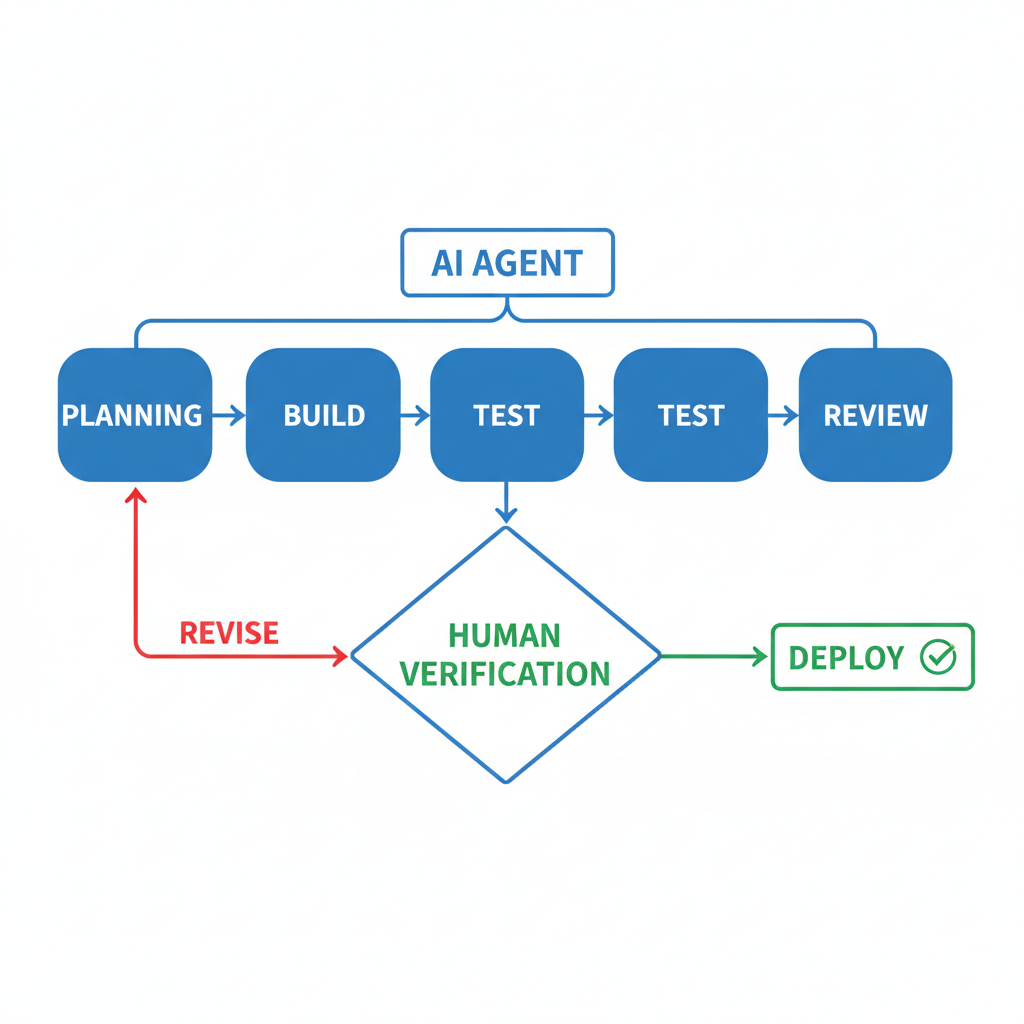
Agentic AI in 2026 acts as a first-pass executor across the software development lifecycle, analyzing feasibility during planning, implementing features during build, expanding test coverage during validation, and surfacing risks during review, compressing weeks of coordination into continuous workflows. In practice this means the system generates boilerplate CRUD operations and data models, suggests test cases, identifies edge cases, analyzes stack traces, generates documentation, summarizes pull requests, and runs automated deployment or build scripts via agents using protocols like MCP. The same agents can draft initial architecture feasibility notes and flag obvious integration risks before any human review begins.
Developers remain responsible for the final 10–40% of the work that involves trade-off decisions, security posture, and release criteria. This division keeps the verifiable, repetitive layers moving while preserving human oversight on higher-order questions. The result is a steady compression of coordination overhead rather than a replacement of engineering judgment.
Guardrails and Metrics That Prevent Slowdowns and Quality Drops
Teams that treat AI tools as plug-and-play additions often see neutral or negative results. Salem Ventures reports that AI code completion tools deliver measurable cycle-time improvements on medium-complexity tasks and that AI developer tools can yield significant productivity gains when paired with process changes, measurement, and guardrails. Practical guardrails therefore center on four tracked metrics: merged PR count per developer, post-merge bug rate, end-to-end PR cycle time, and raw task completion counts.
Process changes include requiring human review of all AI-generated tests before merge and restricting AI use on architecture spikes. Measurement dashboards surface whether time saved on boilerplate actually appears as higher throughput or simply shifts into longer review queues. Medium-complexity features show the clearest improvement; high-complexity work still benefits more from senior review than from first-pass automation.
How AI Automation Affects Junior vs Senior Engineers
Across 4,867 developers at Microsoft, Accenture, and a Fortune 100 firm, access to an AI coding assistant increased the number of completed tasks by about 26%, with particularly strong gains among less experienced developers. Junior engineers accelerate fastest on boilerplate, test generation, and documentation because these tasks match the pattern-recognition strengths of current models. Senior engineers shift their time toward architecture reviews, risk assessment, and cross-team coordination once the volume of routine patches declines.
The same data set shows that the overall productivity lift narrows skill gaps without flattening expertise. Organizations that add explicit review checkpoints and pair junior developers with seniors on AI-drafted modules capture the task-completion gains while protecting code quality. Over-reliance remains a risk when guardrails are absent, but structured workflows turn the 26% average increase into reliable onboarding acceleration.
Solo Developer and Small-Team Playbook for 2026
Solo developers and small teams can apply the same first-pass pattern without enterprise infrastructure. AI automation can free up several hours per day; automating email responses, social media posting, and repetitive reports alone can free up 20–30% of a workweek. The identical logic extends to code: route boilerplate generation, test scaffolding, and documentation drafts to agents, then spend saved hours on architecture or side projects.
Measure personal impact through weekly task completion counts and hours reclaimed for non-routine work. A simple dashboard tracking PR merge velocity and time spent on new features versus maintenance provides the same feedback loop used in larger trials. The pattern scales from single developers to small teams because it rests on process redesign rather than headcount.
By redesigning workflows so AI automation owns the verifiable first 60–90% of repetitive tasks, developers and teams can reclaim hours daily, cut PR cycle times by up to 30%, and redirect energy to architecture, creativity, and side projects, while using clear metrics to confirm real gains.
Sources
- arxiv.org · Abs
- dev.to · Eva Clari 289d85ecc68da48
- refontelearning.com · Blog
- ttms.com · How Ai Is Changing The Work Of Developers Testers And Analysts In 2026
- cio.com · Article
- dev.to · Pixel Mosaic
- linkedin.com · Pulse
- https://papers.ssrn.com (The Effects of Generative AI on High-Skilled Work: Evidence from Three Field Experiments with Software Developers)
Related Articles
Building My First Multi-Agent System with Google’s 1-Hour Agentic Engineering Course
Step-by-step notes from following Google’s free agentic course to wire short-term memory, loops, and MCP-style agents for real automation tasks.

Haiku vs Opus for Real Developer Tasks: 5-Run Coding Benchmarks That Surprised Me
Detailed results comparing smaller models like Haiku against Opus on actual merged bug fixes and daily coding work for developers.

Turning a $599 Mac Mini into a Portable AI Workstation for On-the-Go Automation
Step-by-step setup for a battery-powered local AI machine that handles research, summaries, and workflows without cloud costs.